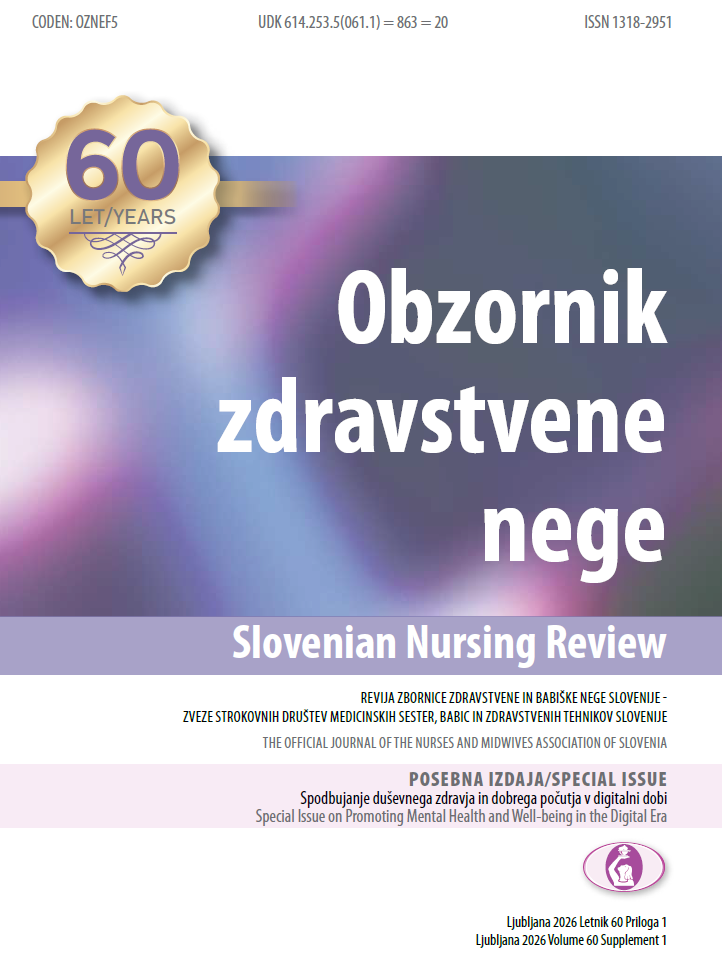
Odnos študentov zdravstvene nege do stigme, povezane z duševnimi težavami in boleznimi
narativni pregled literature
DOI:
https://doi.org/10.14528/snr.2026.60.Suppl.1.3338Ključne besede:
stereotip, mentalno zdravje, zdravstvena nega, zdravstvena oskrbaPovzetek
Uvod: Študenti zdravstvene nege bodo kot prihodnji izvajalci oskrbe pomembno vplivali na kakovost obravnave pacientov z duševnimi težavami in boleznimi, a so njihovi odnosi do teh pacientov še vedno premalo raziskani. Namen pregleda je bil raziskati odnos študentov zdravstvene nege do pacientov s težavami in boleznimi, povezanimi z duševnim zdravjem, z vidika stigme.
Metode: Izveden je bil narativni pregled literature v bazah PubMed in CINAHL Ultimate (EBSCOhost) brez časovne omejitve, z uporabo iskalnega niza v angleškem jeziku. Moč dokazov je bila ocenjena s pomočjo hierarhije dokazov. Za sintezo je bila uporabljena induktivna vsebinska analiza.
Rezultati: Analiziranih je bilo 15 raziskav. Identificirani sta bili dve glavni kategoriji: prisotnost stigme pri študentih zdravstvene nege (negativna naravnanost, izražanje stigme; pozitivna naravnanost, zmanjšanje stigme) in dejavniki, ki vplivajo na stopnjo stigme (vpliv izobraževanja; osebni in demografski dejavniki).
Diskusija in zaključek: Na podlagi ugotovitev predlagamo, da se v programe izobraževanja študentov zdravstvene nege smiselno vključijo klinične izkušnje s pacienti z duševnimi težavami, saj neposreden stik pomembno prispeva k zmanjšanju stigme in razvoju empatije. Prav tako je pomembno, da izobraževalni pristopi okrepijo vsebine o duševnem zdravju, spodbujajo razumevanje kompleksnosti teh težav ter študentom omogočajo razmislek o lastnih stališčih in vrednotah.
Prenosi
Metrike
Literatura
Abuhammad, S., Hatamleh, R., Howard, K., & Ahmad, M. M. (2019). Correlates and predictors of stigmatization of patients with mental illness among nursing students. Journal of Psychosocial Nursing and Mental Health Services, 57(1), 43–51. https://doi.org/10.3928/02793695-20180907-01 PMid:30272809
Alexander, L., Rinehart, N. J., Hay, M., Boyd, L., & Foster, K. (2023). Nursing students’ attitudes and experiences with mental illness: A cross-sectional study. Teaching and Learning in Nursing, 18(1), 72–77. https://doi.org/10.1016/j.teln.2022.09.011
Alexander, L., Sheen, J., Rinehart, N., Hay, M., & Boyd, L. (2018). The role of television in perceptions of dangerousness. Journal of Mental Health Training, Education and Practice, 13(3), 187–196. https://doi.org/10.1108/JMHTEP-02-2017-0006
Amaechi, I. A., Nwani, P. O., & Akadieze, A. O. (2023). Stigmatizing attitude towards mental illness, disabilities, emotional and behavioural disorders, among healthcare students in a Tropical University College of Health Sciences. Journal of Education and Health Promotion, 12, Article 82. https://doi.org/10.4103/jehp.jehp PMid:37288408; PMCid:PMC10243419
American Psychiatric Association. (2020). Stigma, prejudice and discrimination against people with mental illness. https://www.psychiatry.org/patients-families/stigma-and-discrimination
Barry, S., & Ward, L. (2017). Undergraduate nursing students’ understandings of mental health: A review of the literature. Issues in Mental Health Nursing, 38(2), 160–175. https://doi.org/10.1080/01612840.2016.1251515 PMid:27929706
Bilkay, H. İ., Yaman, Ö., Gürhan, N., & Yilmaz-Bingöl, T. (2024). A study on the representation of mental disorders in Turkish newspapers. Journal of Mental Health, 33(2), 185–192. https://doi.org/10.1080/09638237.2023.2245908 PMid:37560795
Bingham, H., & O’Brien, A. J. (2018). Educational intervention to decrease stigmatizing attitudes of undergraduate nurses towards people with mental illness. International Journal of Mental Health Nursing, 27(1), 311–319. https://doi.org/10.1111/inm.12323 PMid:28229546
Cambridge University Press & Assessment. (2025a). Prejudice. In Cambridge English Dictionary. https://dictionary.cambridge.org/dictionary/english/prejudice
Cambridge University Press & Assessment. (2025b). Stereotype. In Cambridge English Dictionary. https://dictionary.cambridge.org/dictionary/english/stereotype
Castro, D., Mehta, P., & Frost, D. M. (2025). A personal but shared burden: Developing a multiple-group internalized stigma scale (MGISS). Group Processes & Intergroup Relations, 28(5), 953–976. https://doi.org/10.1177/13684302241312674
Centers for Disease Control and Prevention. (2023). About mental health. https://www.cdc.gov/mentalhealth/learn/index.htm
Corrigan, P. W., Bink, A. B., Fokuo, J. K., & Schmidt, A. (2015). The public stigma of mental illness means a difference between you and me. Psychiatry Research, 226(1), 186–191. https://doi.org/10.1016/j.psychres.2014.12.047 PMid:25660735
Dubreucq, J., Plasse, J., & Franck, N. (2021). Self-stigma in serious mental illness: A systematic review of frequency, correlates, and consequences. Schizophrenia Bulletin, 47(5), 1261–1287. https://doi.org/10.1093/schbul/sbaa181 PMid:33459793; PMCid:PMC8563656
Fernandes, J. B., Família, C., Castro, C., & Simões, A. (2022). Stigma towards people with mental illness among Portuguese nursing students. Journal of Personalized Medicine, 12(3), Article 326. https://doi.org/10.3390/jpm12030326 PMid:35330326; PMCid:PMC8955632
Fernández, D., Grandón, P., López-Angulo, Y., Vladimir-Vielma, A., Peñate, W., & Díaz-Pérez, G. (2023). Internalized stigma and self-stigma in people diagnosed with a mental disorder: One concept or two? A scoping review. International Journal of Social Psychiatry, 69(8), 1869–1881. https://doi.org/10.1177/00207640231196749 PMid:37646436
Gärtner, L., Asbrock, F., Euteneuer, F., Rief, W., & Salzmann, S. (2022). Self-stigma among people with mental health problems in terms of warmth and competence. Frontiers in Psychology, 13, Article 877491. https://doi.org/10.3389/fpsyg.2022.877491 PMid:35774956; PMCid:PMC9237425
Giralt Palou, R., Prat Vigué, G., Torà Suarez, N., Romeu-Labayen, M., & Tort-Nasarre, G. (2022a). The development of positive attitudes toward mental health among university nursing students: Countering the role of social desirability. Perspectives in Psychiatric Care, 58(4), 1680–1690. https://doi.org/10.1111/ppc.12993 PMid:35328900; PMCid:PMC8955242
Giralt Palou, R., Prat Vigué, G., Romeu-Labayen, M., & Tort-Nasarre, G. (2022b). Analysis of stigma in relation to behaviour and attitudes towards mental health as influenced by social desirability in nursing students. International Journal of Environmental Research and Public Health, 19(6), Article 3213. https://doi.org/10.3390/ijerph19063213 PMid:34873707
Godasi, G., Donthu, R., Mohammed, A., Pasam, R., & Subramanyam, R. (2021). Attitudes toward psychiatrists, psychiatric medications, and mental illness among medical undergraduates: A cross-sectional study. Indian Journal of Social Psychiatry, 37(2), 212–218. https://doi.org/10.4103/ijsp.ijsp_38_20
Government of Canada. (2022). Mental illness. https://www.canada.ca/en/public-health/services/chronic-diseases/mental-illness.html
Granados-Gámez, G., López Rodríguez, M. del M., Corral Granados, A., & Márquez-Hernández, V. V. (2017). Attitudes and beliefs of nursing students toward mental disorder: The significance of direct experience with patients. Perspectives in Psychiatric Care, 53(2), 135–143. https://doi.org/10.1111/ppc.12147 PMid:26813481
Grandón, P., Fernández Vega, D., Sánchez Oñate, A. A., Vielma Aguilera, A. V., Villagrán Valenzuela, L., Vidal Gutiérrez, D., Inostroza Rovengno, C., & Whitley, R. (2022). Mental disorders in the media: A retrospective study of newspaper coverage in the Chilean press. International Journal of Social Psychiatry, 68(7), 1351–1362. https://doi.org/10.1177/00207640211023086 PMid:34254543
Happell, B., Platania-Phung, C., Bocking, J., Scholz, B., Horgan, A., Manning, F., Doody, R., Hals, E., Granerud, A., Lahti, M., Pullo, J., Ellilä, H., Annaliina, V., van der Vaart, K. J., Allon, J., Griffin, M., Russell, S., MacGabhann, L., Bjornsson, E., & Biering, P. (2018). Nursing students’ attitudes towards people diagnosed with mental illness and mental health nursing: An international project from Europe and Australia. Issues in Mental Health Nursing, 39(10), 829–839. https://doi.org/10.1080/01612840.2018.1489921 PMid:30346220
Heim, E., Henderson, C., Kohrt, B. A., Koschorke, M., Milenova, M., & Thornicroft, G. (2020). Reducing mental health-related stigma among medical and nursing students in low- and middle-income countries: A systematic review. Epidemiology and Psychiatric Sciences, 29, Article e28. https://doi.org/10.1017/S2045796019000167 PMid:30929650; PMCid:PMC6848770
Kyngäs, H. (2020). Inductive content analysis. In H. Kyngäs, K. Mikkonen, & M. Kääriäinen (Eds.), The application of content analysis in nursing science research (pp. 13–21). Springer International Publishing. https://doi.org/10.1007/978-3-030-30199-6_2
Lien, Y. Y., Lin, H. S., Lien, Y. J., Tsai, C. H., Wu, T. T., Li, H., & Tu, Y. K. (2021). Challenging mental illness stigma in healthcare professionals and students: A systematic review and network meta-analysis. Psychology & Health, 36(6), 669–684. https://doi.org/10.1080/08870446.2020.1796180 PMid:33017193
Mannarini, S., & Rossi, A. (2019). Assessing mental illness stigma: A complex issue. Frontiers in Psychology, 9, Article 2722. https://doi.org/10.3389/fpsyg.2018.02722 PMid:30687177; PMCid:PMC6336735
Masedo, A., Grandón, P., Saldivia, S., Vielma-Aguilera, A., Castro-Alzate, E. S., Bustos, C., Mascayano, F., Alvarado, R., Tapia, T., López-Angulo, Y., Díaz-Castro, L., Castro-Alzate, E. S., & Moreno-Küstner, B. (2021). A multicentric study on stigma towards people with mental illness in health sciences students. BMC Medical Education, 21(1), Article 324. https://doi.org/10.1186/s12909-021-02695-8 PMid:34092225; PMCid:PMC8183042
McKenna, L., Boyle, M., Brown, T., Williams, B., Molloy, A., Lewis, B., & Molloy, L. (2012). Levels of empathy in undergraduate nursing students. International Journal of Nursing Practice, 18(3), 246–251. https://doi.org/10.1111/j.1440-172X.2012.02035.x PMid:22621294
Melnyk, B. M., & Fineout-Overholt, E. (2023). Evidence-based practice in nursing & healthcare: A guide to best practice (5th ed.). Wolters Kluwer.
Nacionalni inštitut za javno zdravje. (2022). O duševnem zdravju. https://nijz.si/zivljenjski-slog/dusevno-zdravje/
O’Ferrall-González, C., Almenara-Barrios, J., García-Carretero, M. Á., Salazar-Couso, A., Almenara-Abellán, J. L., & Lagares-Franco, C. (2020). Factors associated with the evolution of attitudes towards mental illness in a cohort of nursing students. Journal of Psychiatric and Mental Health Nursing, 27(3), 237–245. https://doi.org/10.1111/jpm.12572 PMid:31663221
Organisation for Economic Co-operation and Development & European Union. (2022). Health at a glance: Europe 2022: State of health in the EU. OECD Publishing.
Page, M. J., McKenzie, J. E., Bossuyt, P. M., Boutron, I., Hoffmann, T. C., Mulrow, C. D., Shamseer, L., Tetzlaff, J. M., Akl, E. A., Brennan, S. E., Chou, R., Glanville, J., Grimshaw, J. M., Hróbjartsson, A., Lalu, M. M., Li, T., Loder, E. W., Mayo-Wilson, E., McDonald, S., … Moher, D. (2021). The PRISMA 2020 statement: An updated guideline for reporting systematic reviews. BMJ, 372, Artilce n71. https://doi.org/10.1136/bmj.n71 PMid:33782057; PMCid:PMC8005924
Patterson, C., Perlman, D., Moxham, L., Sudhakar, C., Nayak, A. K., Velayudhan, B., Jose, T. T., & Tapsell, A. (2021). Australian and Indian nursing students’ skills and attitudes surrounding mental illness: Preparing for a transnational nursing education collaboration. Nurse Education in Practice, 50, Article102909. https://doi.org/10.1016/j.nepr.2020.102909 PMid:33285402
Polit, D. F., & Beck, C. T. (2021). Nursing research: Generating and assessing evidence for nursing practice (11th ed.). Wolters Kluwer.
Ponte, D., Tavares, C., Alves, P., Quesado, A., Ferreira, A., & Quesado, A. (2023). Atitudes dos estudantes de enfermagem perante a pessoa com doença mental. Revista de Investigação & Inovação em Saúde, 6(1), 35–48. https://doi.org/10.37914/riis.v6i1.268
Quinn, D. M., Williams, M. K., & Weisz, B. M. (2015). From discrimination to internalized mental illness stigma: The mediating roles of anticipated discrimination and anticipated stigma. Psychiatric Rehabilitation Journal, 38(2), 103–108. https://doi.org/10.1037/prj0000120 PMid:25799296
Raj, C. T. (2022). The effectiveness of mental health disorder stigma-reducing interventions in the healthcare setting: An integrative review. Archives of Psychiatric Nursing, 39, 73–83. https://doi.org/10.1016/j.apnu.2022.03.005 PMid:35688548
Roach, A., & Tadesse, R. (2023). “It is OK not to be OK”: Nursing students’ backgrounds and perceptions of mental health stigma and implications for mental health nursing education. Issues in Mental Health Nursing, 44(10), 1050–1058. https://doi.org/10.1080/01612840.2023.2245577 PMid:37851476
Rodríguez-Almagro, J., Hernández-Martínez, A., Rodríguez-Almagro, D., Quiros-García, J. M., Solano-Ruiz, M. D. C., & Gómez-Salgado, J. (2019). Level of stigma among Spanish nursing students toward mental illness and associated factors: A mixed-methods study. International Journal of Environmental Research and Public Health, 16(23), Article 4870. https://doi.org/10.3390/ijerph16234870 PMid:31816966; PMCid:PMC6926928
Saito, A. S., & Creedy, D. K. (2021). Determining mental health literacy of undergraduate nursing students to inform learning and teaching strategies. International Journal of Mental Health Nursing, 30(5), 1117–1126. https://doi.org/10.1111/inm.12874 PMid:33913226
Samari, E., Seow, E., Chua, B. Y., Ong, H. L., Abdin, E., Chong, S. A., & Subramaniam, M. (2018). Stigma towards people with mental disorders: Perspectives of nursing students. Archives of Psychiatric Nursing, 32(6), 802–808. https://doi.org/10.1016/j.apnu.2018.06.007 PMid:30454624
Sari, S. P., & Yuliastuti, E. (2018). Investigation of attitudes toward mental illness among nursing students in Indonesia. International Journal of Nursing Sciences, 5(4), 414–418. https://doi.org/10.1016/j.ijnss.2018.09.003 PMid:31406843; PMCid:PMC6626280
Shammari, M., Waggas, D. S., & Hasan, A. A. (2020). Assessment of nursing students’ attitudes and stigma towards mental illness: A cross-sectional study. Journal of Nursing Education and Practice, 10(9), 1–13. https://doi.org/10.5430/jnep.v10n9p1
Sittner, M., Rechenberg, T., Speerforck, S., Angermeyer, M. C., & Schomerus, G. (2024). “Broken souls” vs. “mad ax man”: Changes in the portrayal of depression and schizophrenia in the German media over 10 years. Epidemiology and Psychiatric Sciences, 33, Article e37. https://doi.org/10.1017/S204579602400043X PMid:39291371; PMCid:PMC11450423
Smith, B. (2015). Mental illness stigma in the media. The Review: A Journal of Undergraduate Student Research, 16(1), 50–63.
Stuart, H. (2016). Reducing the stigma of mental illness. Global Mental Health, 3, Article e17. https://doi.org/10.1017/gmh.2016.11 PMid:28596886; PMCid:PMC5314742
Stuhlmiller, C., & Tolchard, B. (2019). Understanding the impact of mental health placements on student nurses’ attitudes towards mental illness. Nurse Education in Practice, 34, 25–30. https://doi.org/10.1016/j.nepr.2018.11.007 PMid:30513455
Valentim, O., Moutinho, L., Laranjeira, C., Querido, A., Tomás, C., Longo, J., Correia, T. (2023). “Looking beyond mental health stigma”: An online focus group study among senior undergraduate nursing students. International Journal of Environmental Research and Public Health, 20(5), Article 4601. https://doi.org/10.3390/ijerph20054601 PMid:36901609; PMCid:PMC10002096
World Health Organization. (2022). Mental health. https://www.who.int/news-room/fact-sheets/detail/mental-health-strengthening-our-response
Prenosi
Objavljeno
Kako citirati
Številka
Rubrike
Licenca
Avtorske pravice (c) 2026 Obzornik zdravstvene nege

To delo je licencirano pod Creative Commons Priznanje avtorstva-Nekomercialno-Brez predelav 4.0 mednarodno licenco.
Na Obzornik zdravstvene nege, Ob železnici 30A, 1000 Ljubljana, prenašam naslednje materialne avtorske pravice: pravico reproduciranja v neomejeni količini, in sicer v vseh poznanih oblikah reproduciranja, kar obsega tudi pravico shranitve in reproduciranja v kakršnikoli elektronski obliki (23. čl. Zakona o avtorski in sorodnih pravicah – v nadaljevanju ZASP); pravico distribuiranja (24. čl. ZASP); pravico dajanja na voljo javnosti vključno z dajanjem na voljo javnosti prek svetovnega spleta oz. računalniške mreže (32.a čl. ZASP); pravico predelave, zlasti za namen prevoda (33. čl. ZASP). Prenos pravic velja za članek v celoti (vključno s slikami, razpredelnicami in morebitnimi prilogami). Prenos je izključen ter prostorsko in časovno neomejen.